Main Features
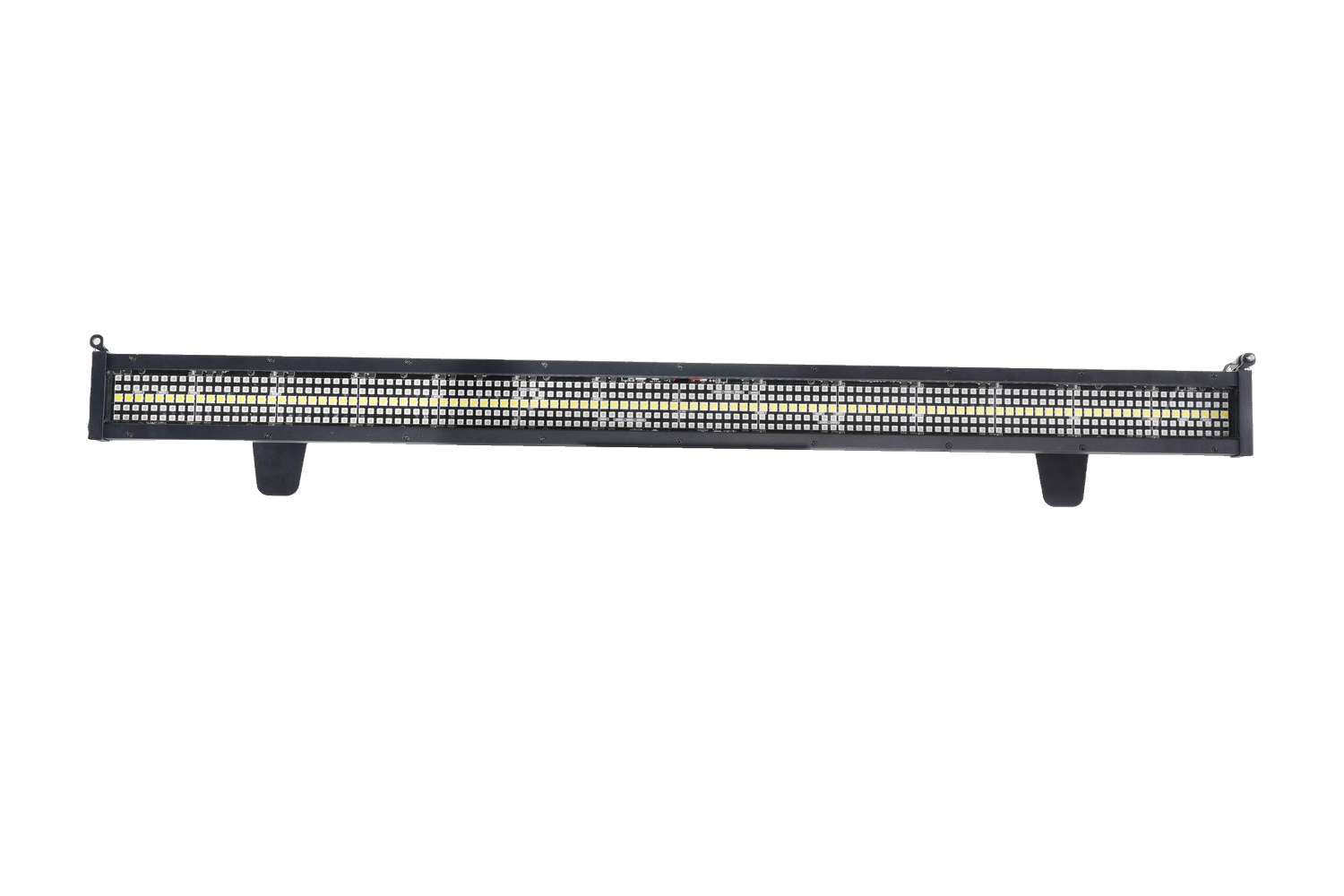
The 960B II steps up to 235W, 112 white SMD5050 strobe LEDs and 48 individually addressable RGB segments with up to 152CH of DMX — the same 120° throw and 8 white zones, with far finer control over every color pattern.
48 RGB Segments Instead Of 8
This is the headline change from the standard 960B. Where the 960B splits its color into 8 RGB sections, the 960B II splits into 48. A chase no longer jumps from block to block — it rolls. Waves, races and color gradients travel down the bar in smooth increments, which is what makes a bar of light look programmed rather than switched on. The 8 white segments stay where they were, so the strobe layout is familiar if you already run PULSARIS units.
More Power And A Bigger White Bank
Power climbs to 235W, and the dedicated white strobe bank grows to 112 SMD5050 LEDs. In practice that means the white hit is brighter and holds its own against a full color wash, instead of getting lost under it. For a club or a touring rig running haze, that extra white headroom is the difference between a strobe you feel and a strobe you notice.
Up To 152 DMX Channels
The 960B II carries four personalities: 4CH, 15CH and the full 152CH. At 152CH every one of the 48 RGB segments and 8 white segments answers to its own channels, so you can offset patterns, run a gradient across the bar, or hold half the fixture in a static color while the other half chases. Four channels when you are short on universe, 152 when you are not.
A Sharper, More Programmable Color Engine
The color side of the fixture is grouped more finely than the standard 960B was, so the II trades raw LED count for resolution. Those extra segments are the whole point: they let a pattern travel rather than jump, and they let a designer hold one half of the bar in a static color while the other half runs a chase. If you are buying this fixture for programmed looks, that is the feature you are paying for.
120° Beam, Fewer Fixtures
The wide 120° beam angle is unchanged from the 960B, and it is the reason two or three units can cover a mid-sized stage rather than six narrow fixtures. Fewer positions means less truss, less cable and a quicker load-out at 1am — which is the part of the job nobody puts in the spec sheet.
Built-In Macros With No Programming
The fixture ships with high-brightness strobe and a full set of macro effects already loaded, covering color chasing, racing and pulsing. On a one-nighter you can pull up a macro and look prepared without writing a cue. Linears dimming runs the full 0–100% range and the strobe spans 1–25Hz, so fades stay clean and the strobe can be set from a slow throb to a full-speed hit.
3.6 kg Each, 10 To A Road Case
At 3.6 kg (7.9 lb) with PowerCon in/out and 3-pin XLR, the 960B II is built to be handled night after night. PowerCon daisy-chaining keeps the power runs short when you hang a row of them. The 10 PCS & 1 ROAD CASE package at $1,849 arrives as one flight-ready box, so a full rig checks in as a single case instead of ten loose fixtures.
WHO IT’S BUILT FOR
Clubs and touring rigs
The 48 RGB segments are what you buy this fixture for. Over a dance floor, a chase rolls across the full width of the bar in smooth increments, and the 8 white segments punch on top with 112 LEDs behind them. Hanging four or five across a ceiling gives you patterns that look designed rather than preset.
Lighting designers and programmers
152 channels of DMX on a strobe-effect bar is unusual, and it is the reason this fixture suits programmed shows. Offset the 48 RGB segments to build gradients, hold color under a white chase, or run a wave against a race on the same fixture. You can also drop to 15CH when a universe is crowded and get most of the look.
Mobile DJs stepping up
If you have been running the 960B and want more resolution without learning a new fixture, the 960B II keeps the same 120° beam, the same 8 white zones and the same PowerCon and XLR layout. Auto, Sound-Active and Master-Slave modes still work with no console, so the upgrade does not force you onto a desk.
Rental houses and production companies
One SKU covering color effects and white strobe keeps rental stock simple. Four-unit boxes at $669 suit small hires; the 10 PCS & 1 ROAD CASE at $1,849 suits events that go out as a full kit. PowerCon in/out and a 3.6 kg (7.9 lb) body mean the case stays a one-person lift.
Indoor use only
The PULSARIS 960B II carries an IP20 rating and is built for stages, clubs, theatres and covered venues. For outdoor or weather-exposed events, choose an IP65-rated fixture from our outdoor range instead.
Where It Fits
Strobes and effect bars are the punctuation of the night: club drops, band peaks, DJ booths, small venue shows and party moments.
FREQUENTLY ASKED QUESTIONS
What makes the PULSARIS 960B II different from other LED strobe bars?
Resolution and depth of control. The fixture divides its RGB output into 48 individually addressable segments and its white strobe into 8 segments, and it exposes up to 152 DMX channels to drive them. Most strobe bars offer a handful of sections and a fraction of the channels, which caps how detailed your patterns can get. Here a chase can roll smoothly across the full bar width instead of jumping between blocks.
Is the 960B II bright enough for a large room?
It draws 235W and carries a dedicated bank of 112 white SMD5050 LEDs, plus 768 RGB SMD5050 LEDs for the color side. The 120° beam angle spreads that output wide and even, so a handful of units light a full dance floor. In a hazy club the white strobe holds its own against a running color wash rather than disappearing under it.
How many units do I need for my room?
Two units cover a small dance floor at the 120° beam angle. Four suits a mid-sized stage or club floor and ships as a BOX OF 4PCS at $669. For a full club install or a touring kit, the 10 PCS & 1 ROAD CASE package at $1,849 ships as one flight case.
Do I need a console to use all the channels?
No, and you probably should not start there. Master-Slave, Auto and Sound-Active modes run with nothing attached, and 4CH gives you a working effect on a crowded universe. 152CH is there for when you have a desk and want per-segment control — open it for the programmed shows, keep it closed for the quick ones.
Can I use it outdoors?
No. The PULSARIS 960B II is IP20-rated for indoor use only — clubs, stages, theatres and covered venues. For outdoor or weather-exposed events, choose an IP65-rated fixture from our outdoor range instead.
How is it powered and how does it ship?
Universal AC100–240V at 50/60Hz, drawing 235W, with PowerCon in/out for daisy-chaining and 3-pin XLR for DMX. Each fixture is 3.6 kg (7.9 lb) and 448 × 210 × 175 mm. Every order includes free USA shipping on most products, a 2-year warranty and a 30-day return policy.
Will it last through a heavy tour schedule?
The LEDs are rated for 50,000 hours of average life, dimming is linear across 0–100% and the strobe runs 1–25Hz. PowerCon and XLR connectors are the standard touring fittings, so spares are easy to source on the road. At 3.6 kg (7.9 lb) it is a fixture you can rig and strike night after night.







Reviews