Main Features
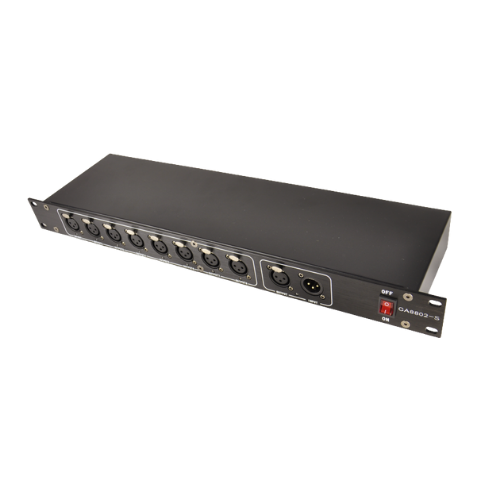
A 1-in / 8-out DMX distribution amplifier with optically isolated branches, ground loop isolation above AC 300V and signal regeneration — 19″ 1U, 4.2 lbs, built to sit in the rack for good.
Star Wiring, Not Daisy Chaining
DMX is a bus, and a long daisy chain is where it starts to fail: the fixtures at the end of the run get a degraded signal, and one bad connector takes the whole line down. The Splt-802 turns one feed into 8 independent branches, so you can star-wire the rig the way the venue is actually laid out — one leg to the truss, one to the floor cans, one to the dimmers, one to the effects rack. Each branch fails on its own.
Full Electrical and Ground Isolation
Every one of the 8 outputs is optically isolated, with an input-to-output withstand voltage above AC 300V. In practice that is the fix for the two problems that ruin a rig's data: ground loops formed when stage and booth share a power source, and voltage differences between fixtures on different circuits. The result is stable, predictable DMX instead of intermittent flicker you cannot reproduce until the show starts.
Signal Amplification and Regeneration
The splitter does not just copy the incoming signal, it amplifies and reshapes it. DMX512 edges get squared back up on the way out, which is what lets you run longer cable from the splitter to the last fixture and still have the data arrive clean. On a large rig that is the difference between a fixture responding every time and one that drops the occasional frame.
1 Input, 1 Through Output, 8 Branches
The chassis takes one signal input and provides one through output, isolated from each other and from the distribution branches. The through line is what lets you grow past 8 branches without buying a bigger unit: feed the next splitter from it and keep every leg isolated. It is the same way you would expand a network switch, and it means the box you buy for a small rig does not become dead stock when the rig grows.
Built for the Rack
At 19.1 × 1.8 × 5.5 in the Splt-802 is a 19″ rack mount, 1U height enclosure in metal, weighing 4.2 lbs. Signal connectors are XLR-3 male on the input and XLR-3 female on the outputs — the standard 3-pin DMX connectors already in every cable case — over an RS-485 interface. Nothing about it needs a special adaptor.
15W on Universal Mains
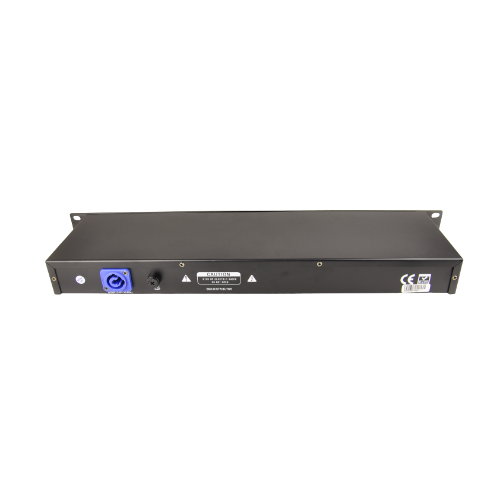
Power is AC 90–240V at 50/60Hz and the unit draws 15W, so it works on US and European mains without a transformer and adds effectively nothing to the rack's current load. That universal input matters for rental stock that ships between territories, and for venues where the power situation is not what the paperwork promised.
WHO IT’S BUILT FOR
Rental houses and touring rigs
A splitter is the cheapest insurance in the truck. Star-wire each show instead of chaining 20 fixtures in a line, isolate the stage from the booth, and when something misbehaves you can pull one branch instead of troubleshooting the whole universe. The 1U metal chassis survives the road the way a plastic box does not.
Clubs, bars and installed venues
Permanent installs are where ground loops are worst, because stage power and booth power are rarely on the same panel. Isolated outputs and an input-to-output withstand voltage above AC 300V settle that once, in the rack, instead of every time a new fixture gets added.
Churches and multi-room facilities
Sunday service on one branch, the overflow room on another, lobby decor on a third. Each leg carries its own universe of fixtures and none of them can pull the others down. It also means a single failed cable affects one room rather than the whole building.
Large rigs that keep growing
The through output lets you stack splitters as the rig expands, keeping every branch isolated rather than reverting to a long daisy chain. Buy one for the first 8 branches, add a second when you need 16, and keep the same rack footprint.
Indoor rack use only
The DMX SPLITTER is a 19″ 1U rack device built for equipment racks in covered positions, and it carries no weather rating. Keep it out of rain and standing water — where a rig has to live outdoors, house the rack under cover rather than exposing the splitter.
FREQUENTLY ASKED QUESTIONS
Why do I need a DMX splitter if I can just daisy-chain my fixtures?
Because a daisy chain is a single point of failure. One bad connector or one damaged cable anywhere in the line takes down every fixture after it, and the fixtures at the far end receive a weaker signal. A splitter gives you 8 isolated branches, so each part of the rig fails independently and each leg gets a regenerated signal.
What does "optically isolated" actually do for me?
It breaks the electrical connection between the input and each output, so no current can travel along the DMX cable between them. That eliminates ground loops — the usual cause of hum, flicker and intermittent data — which appear when stage and booth equipment sit on different power circuits. The isolation is rated to withstand more than AC 300V.
How many outputs does it have — 8 or 4?
The unit provides 8 electrically isolated distribution outputs, or 4 depending on the configuration. It also has one signal input and one through output, isolated from each other, so you can feed a second splitter from the through line when 8 branches are no longer enough.
Will it work in a 19-inch equipment rack?
Yes — it is built for one. The chassis is 19.1 × 1.8 × 5.5 in, which is a 19″ rack mount at 1U height, and it weighs 4.2 lbs. Connectors are XLR-3 male for the input and XLR-3 female for the outputs, so standard 3-pin DMX cables plug straight in.
Can the splitter be used outdoors?
No. It is an indoor rack device with no weather rating, designed to live in an equipment rack. For outdoor events, keep the rack under cover rather than exposing the unit to rain or standing water.
What power does it need?
AC 90–240V at 50/60Hz, drawing 15W. The wide input range means it runs on both US and European mains without a step-down transformer, and at 15W it adds almost nothing to the rack's total load.
How far can I run cable from the splitter?
The splitter amplifies and reshapes the DMX512 signal on the way out, which is what preserves data integrity over longer cable runs than a plain daisy chain allows. Signal travels over an RS-485 interface on standard XLR-3 connectors, and each of the isolated branches carries the regenerated signal independently. Free shipping on most products across the USA and a 30-day return policy come with every order.





















Reviews