
Walk into a venue these days, and you notice something almost instantly. Light behaves differently. It feels sharper, more controlled, almost intentional in the way it shapes a room. Many professionals suggest that this shift happened when LED stage lights became standard tools rather than optional upgrades. You have seen the difference yourself during a show where colors seemed to hang in the air or movement effects swept across the stage with near-perfect precision. It did not always work that smoothly in older lighting systems, and that contrast tells a story.
That story keeps growing as productions lean on smarter, quieter, and more efficient lighting equipment.
There is a simple reason people keep replacing old fixtures. LED stage lights solve problems that once slowed down events. Heat issues used to be a constant complaint. Bulbs burned out at the worst possible moment. Energy costs climbed. Crews had to build entire plans around the limits of their fixtures.
The newer systems changed that pattern. LEDs run cooler. They last longer. Many of them draw less power than a single coffee maker. They also allow color mixing that feels far smoother than what older gel systems ever managed. Professionals in theaters, touring companies, churches, and clubs have noticed that flexibility appears to drive most of today’s upgrades.
Still, not every fixture works the same way. Knowing the types helps prevent costly guesses.
Some productions rely on only a few lights. Others fill their rig with dozens. The right combination depends on what you want people to see, feel, or focus on.
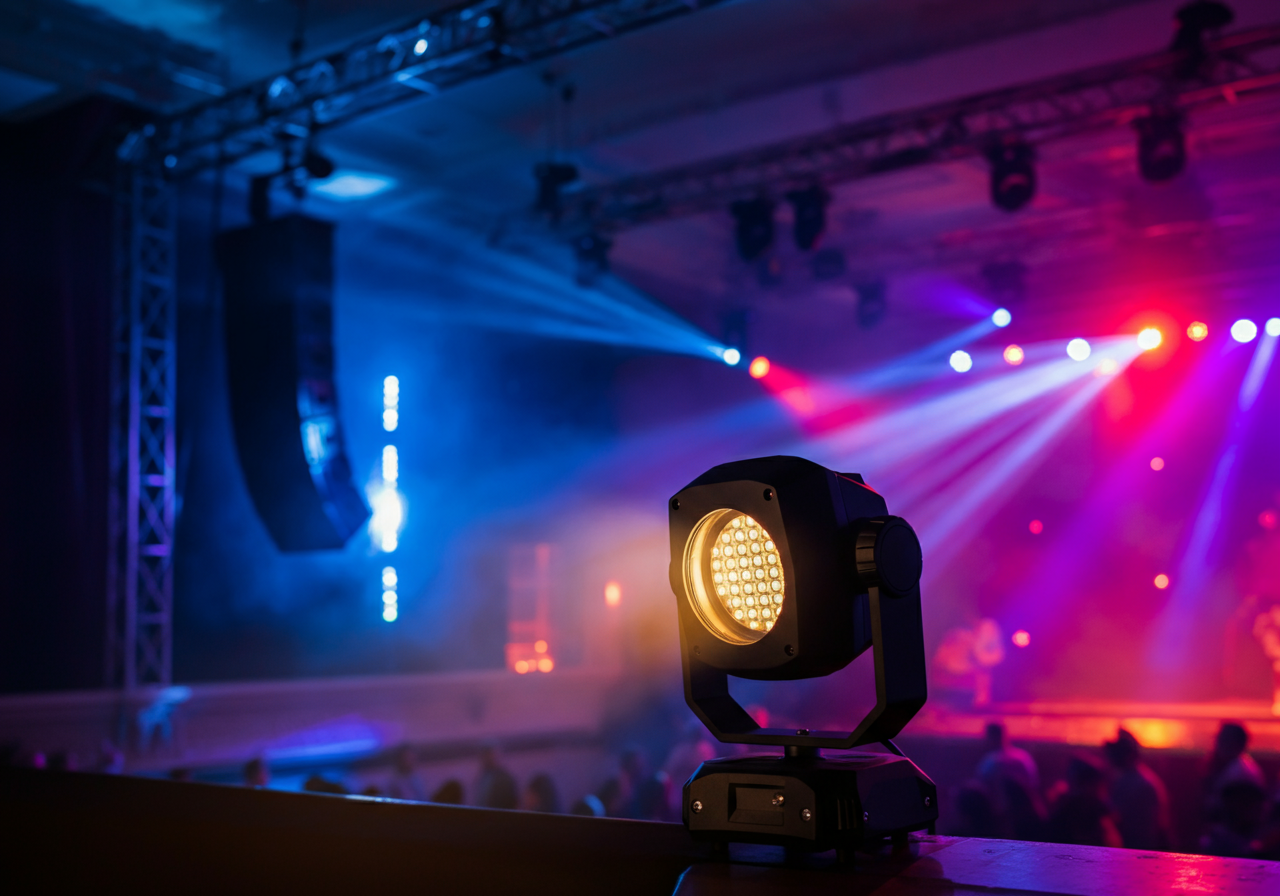
People who want motion in their shows often choose moving head lights. These fixtures pivot, pan, and tilt with surprising smoothness. A few models respond so quickly that operators sometimes slow them down to match the pace of a performance. Automated moving head lights may create aerial beams, textured washes, or fast sweeps across an audience. They also serve DJs and small venues because a single unit can do the work of several older fixtures if programmed carefully.
A stage without a base layer of light feels empty. Wash fixtures solve that issue by spreading soft, even coverage across performers. They may not draw attention on their own, but everything else looks better because of them. Many LED stage lights fall into this category because LEDs can create broad, consistent color fields without flicker.
Whenever you want the audience to follow a moment, a person, or a specific movement, spotlights do the heavy lifting. They create tighter beams that hold attention. Good spots can cut through dense atmospheres created by haze or fog machines. In professional stage lighting setups, these lights often sit on trusses or towers to achieve the right angle and punch.
Bar fixtures stretch light across lines rather than points. Some rigs use them to wash backdrops. Others place them under risers or behind performers to outline shapes. Bars are common in concerts because they stack well and produce bold visual accents.
Strobes produce bursts of illumination that freeze motion. They can be aggressive if overused. Some designers sprinkle them into moments where tension builds, or beats hit hard. Newer models create softer variations, too. DJ stage lights also borrow many of these effects since they can fill a room quickly and match fast music patterns.
Lights do more than brighten a stage. Event lighting guides emotion. It shifts the story and changes how audiences interpret what is in front of them. Some of this is science. Color temperature can influence how people feel about a performer. Cool tones may appear distant or sharp, while warm tones often feel inviting. It is not perfect psychology, but patterns emerge when you do enough shows.
Brightness levels matter too. A slightly dimmed wash can make a scene look intimate. A sudden burst at full intensity can feel like opening a curtain to a new world. Designers experiment constantly because the same fixture behaves differently in a club, a church, or an arena.
If you have ever watched a rehearsal where lights were missing, you know the difference. Everything looks flat, sometimes confusing. Once the rig turns on, scenes snap into place.
Professionals look beyond color and movement. They care about what happens behind the scenes. A fixture looks impressive at first glance, yet small details determine long-term reliability.
Older lights roasted everything nearby. LEDs run cooler, although heat still exists in the electronics. Quiet cooling fans or passive thermal systems can make or break recordings or worship services where noise levels matter.
Control systems let operators shape every scene. DMX remains a standard, and using a reliable DMX controller helps manage fixtures that now support wireless options, Art-Net, and other advanced protocols. These features reduce cable runs and speed up load-ins.
Durability is underrated until you drop a case or handle outdoor events. A fixture built with metal housings and reinforced mounts protects internal components and increases long-term stability.
RGB, RGBW, RGBWA, and RGBWA UV mixes all deliver different results. The broader the color combination, the smoother the transitions appear.
Where someone installs LED stage lights influences how they use them. A touring company may pack a truck with high-output fixtures to handle arenas. A church might prefer silent, energy-efficient units that blend into the ceiling. A small club could use compact DJ stage lights to handle both music nights and private events.
Moving head lights dominate most concert rigs. Designers love their flexibility. They fill space quickly, move with the music, and handle demanding cues without hesitation. Bars and strobes layer on top for extra punch.
Theater designers often blend washes and spots to maintain visibility while shaping mood. LEDs help reduce heat on performers, which some actors greatly appreciate during long shows.
Quiet operation and clean color mixing matter here. Volunteers may run the system, so intuitive fixtures with simple menus work best.
Flicker-free performance is non-negotiable when cameras enter the room. LEDs usually perform well in this area, but testing remains important.
Clients want polished, consistent lighting that enhances presentations without distraction. Washes and soft effects often play the lead role.
| Light Type | Main Purpose | Typical Environments |
| Moving Head Lights | Motion effects, beams, aerials | Concerts, clubs, and DJ shows |
| Wash Lights | Broad coverage and ambiance | Theaters, worship spaces |
| Spot Fixtures | Focused illumination | Stage plays, speakers |
| Bar Lights | Linear accents and backdrop lighting | Concerts, outdoor stages |
| Strobes | Dramatic bursts and motion freeze | Clubs, high-energy shows |
People sometimes hesitate before upgrading aging fixtures. The cost seems high at first glance. Yet many operators realize that LEDs last far longer than traditional bulbs. They use less power, lower cooling costs, and cut maintenance time. Over years of bookings or services, the savings show up in line items that once ran higher.
Brightness output also holds up better. LEDs maintain a stable color spectrum over time. This consistency matters in professional stage lighting since designers want predictable results from cue to cue.
Even so, no single fixture solves everything. The best rigs mix types to cover wide areas, create depth, and maintain focus where it matters.
If you have reached the stage where you want more control or clarity in your events, it may help to look at what industry suppliers offer. Sanyi Lights is one example many creators reference when comparing options. Their catalog includes moving heads, bar fixtures, strobes, and other equipment designed for reliability across concerts, churches, and special events. The appeal seems to come from long-term durability and straightforward integration rather than flashy marketing. Still, explore your needs first. The right choice depends on venue size, show style, and how often you run events.
Explore Sanyi Lights Today – Find the Perfect Fixtures for Your Venue and Take Full Control of Your Show!
A long list would feel repetitive, so here are the advantages that professionals talk about most often.
Performers notice instantly when the temperature on stage does not climb. Cooler fixtures protect costumes, instruments, and sensitive backdrops.
Large rigs once required heavy power distribution. LEDs lighten that load and reduce venue strain.
Crews replace fewer parts because LEDs last for thousands of hours.
Modern fixtures produce saturated colors with minimal drifting.
Because LED stage lights come in so many sizes and formats, almost any venue can build a tailored setup.
It may help to start with questions rather than products. What mood do you want? How large is the space? Do you need quiet gear for worship or broadcast environments? Will you travel with the fixtures? The answers guide your choices more effectively than brand names alone.
People sometimes follow trends without considering their own layouts. A club may not need large moving head lights. A small studio might require soft washes instead. It is believed that walking through a few test scenes under different fixtures can clarify decisions faster than reading technical sheets.
Discover Your Ideal Setup with Sanyi Lights Match the Right Fixtures to Your Space, Mood, and Event Needs!
The world of lighting keeps shifting. New fixtures appear every year with updated optics, smoother dimming curves, and more adaptable control systems. Yet the core advantage stays the same. LED stage lights give designers the ability to shape shows with precision and less compromise. If your venue has reached a point where lighting feels limiting, exploring an upgrade may change far more than you expect. The right beam at the right moment can alter a room.
Yes. Many compact fixtures perform well in small rooms and still offer strong color output.
They create motion, color changes, and beam effects that match music pacing.
In most setups, they do, often by a noticeable margin.
Modern fixtures usually exceed the brightness of older bulbs.
Many run for thousands of hours, although the actual lifespan varies by model.

