
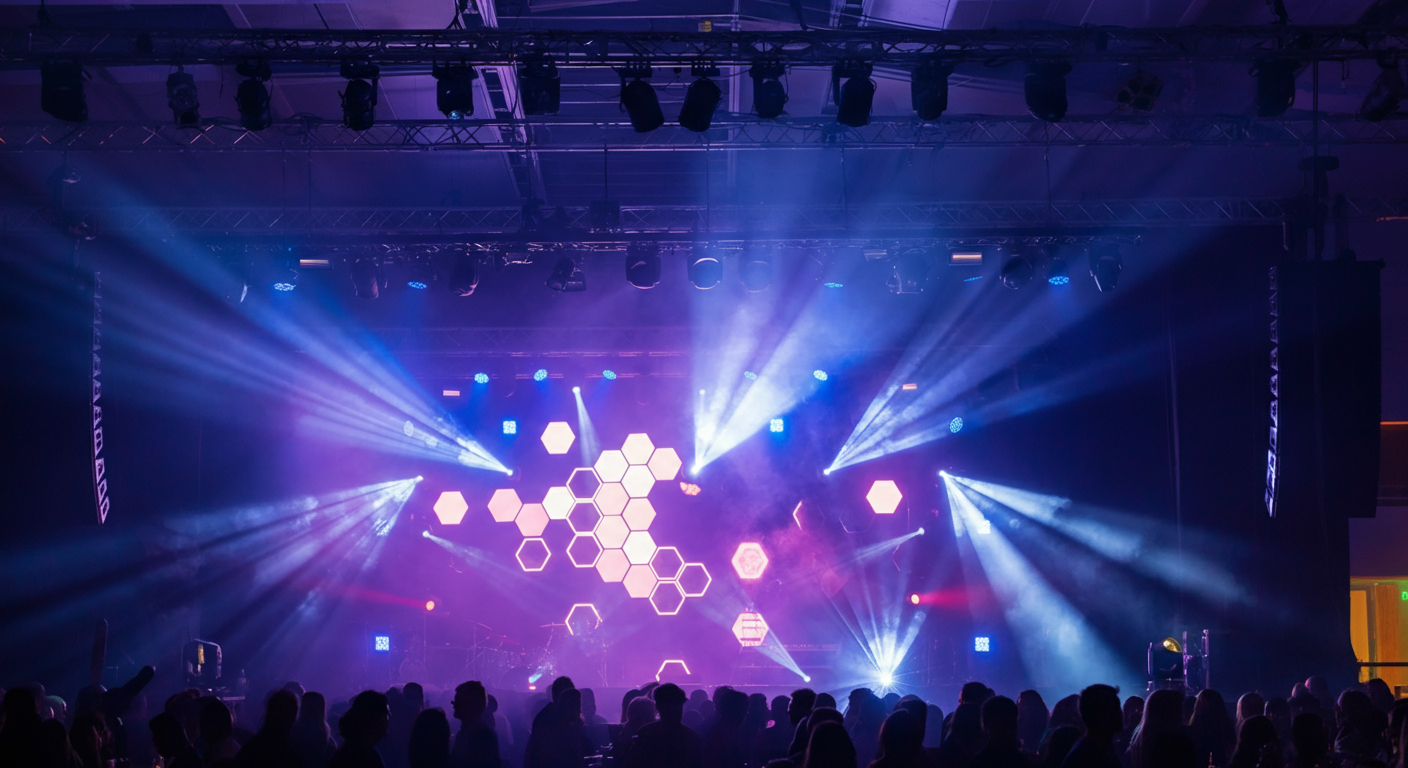
A venue goes quiet. Rigging hums faintly overhead. Then light hits the stage, sharp or soft, static, which means it changes instantly. This shift rarely happens by accident. It comes from choosing the right types of lights and knowing how they behave once powered on.
Stage and event lighting does not rely on a single fixture doing everything. It works because multiple types of lights interact, overlap, sometimes clash, and occasionally leave deliberate gaps. Understanding those differences matters, whether planning a concert, exhibition, corporate launch, or DJ setup.
What follows is not a catalog-style list. It is a practical breakdown of how different types of lights function in real stage lighting and event lighting environments, including where each shines and where limitations appear.
Before any gear is considered, lighting designers think in terms of purpose: coverage, accent, motion, atmosphere, and contrast. Only after those roles are defined do they choose the lights that best bring them to life.
Some fixtures flood a space. Others carve narrow lines through haze. A few exist mainly to move, spin, and surprise. This separation explains why professional stage light types are rarely interchangeable.
Wash fixtures handle one job above all else. Even illumination.
A wash light spreads light broadly, softening edges and filling surfaces without drawing attention to the fixture itself. In stage lighting, this becomes the visual base layer.
Color mixing plays a large role here. Modern wash light systems rely heavily on RGBW or RGBWA LEDs, allowing smooth transitions rather than abrupt color jumps. That smoothness matters more than brightness in many settings.
Wash lights appear often in theaters, broadcast studios, conferences, and large-scale event lighting, where faces and scenery must stay readable.
Wash fixtures rarely create drama on their own. Without contrast from sharper types of lights, a stage can look flat. This is where dynamic lighting enters the picture.
If wash lights create the canvas, beam light defines the lines.
A beam light produces an extremely narrow, concentrated shaft. Often just a few degrees wide. In haze or fog, that beam becomes visible, almost solid.
Beam lights are common in concerts, festivals, and DJ lighting setups and effects because they cut through space rather than lighting surfaces. Movement amplifies this effect, especially when synchronized to music.
Used excessively, beam light can overwhelm an audience or distract from performers. Precision demands restraint. Designers often limit beam fixtures to accents rather than continuous output.
Static lighting has its place, but movement adds narrative.
A moving head is simply a motorized fixture capable of pan, tilt, and often zoom, color change, and gobo projection. It allows one light to cover multiple positions without being physically relocated.
In stage lighting, moving head fixtures reduce rigging complexity while increasing flexibility.
A beam moving head prioritizes intensity and narrow focus. Spot versions balance beam width and gobo detail. Wash moving heads favor spread and color blending.
Choosing among them depends on intent, not trends. For dynamic lighting designs, mixing all three often produces the most control.
Despite newer technology, LED PAR fixtures remain everywhere.
LED PARs offer durability, low power consumption, and consistent output. They are commonly used for uplighting, backlighting, and side washes in event lighting setups.
They rarely steal attention, which is exactly why they stay relevant.
Beam control is limited. Without accessories, spills can become an issue. Still, their reliability keeps them firmly embedded in professional stage light types.
Not every light exists to illuminate.
Strobe fixtures produce rapid bursts of intense light. In concerts and DJ environments, they heighten energy during climactic moments. Used sparingly, they feel powerful. Used constantly, they fatigue audiences.
Blinders face outward. Their purpose is psychological as much as visual. Short bursts aimed toward the crowd create connection and intensity. Event lighting designers tend to reserve blinders for musical peaks or announcements.
Beyond coverage and beams lies texture.
Effect lighting projects shapes, logos, or abstract patterns across surfaces. In corporate events, this may include branding. In entertainment, it leans toward motion and repetition.
Lasers, while striking, require careful safety consideration and are often regulated differently from standard stage lighting.
| Lighting Type | Primary Role | Common Use Cases | Key Limitation |
| Wash Light | Broad coverage | Theater, conferences, stages | Low visual drama |
| Beam Light | Narrow focus | Concerts, festivals | Overuse causes clutter |
| Moving Head | Motion and flexibility | Touring shows, events | Higher cost |
| LED PAR | General illumination | Uplighting, backlight | Limited beam control |
| Strobe | Energy spikes | DJ sets, live music | Audience fatigue |
| Blinder | Crowd engagement | Concert climaxes | Not for continuous use |
Small venues benefit from fewer fixture types used creatively. Large venues demand separation of roles. What works in a ballroom may fail outdoors.
It is believed that mismatched scale, not poor equipment, causes most lighting failures.
Dynamic lighting designs respond to ceiling height, viewing distance, and ambient light. Ignoring these variables leads to wasted output and visual noise.
Lighting control protocols matter. DMX universes, channel counts, and redundancy planning shape real-world performance.
Event lighting setups frequently suffer when fixtures exceed controller capacity. This is not glamorous, but it is essential.
At this point, the types of lights should feel clearer, along with where compromises exist. If sourcing equipment becomes the next step, some manufacturers focus heavily on durability and consistency rather than novelty.
Sanyi Lights is referenced in professional stage lighting discussions due to its long-term manufacturing background, global availability, and focus on beam lights, wash lights, and moving head systems designed for repeated use rather than one-off shows.
Build shows that last—choose Sanyi Lights for consistent, road-ready performance you can rely on, not trends you replace.
Stage lighting works because of contrast. Stillness against motion. Softness interrupted by sharp edges. Every type of light introduces a strength and a limitation.
Design improves when those limits are respected rather than forced.
The most effective event lighting rarely announces itself. It supports, enhances, and occasionally disappears, letting attention fall where it belongs.
And that balance is never fully settled. It keeps shifting. Slightly. Every show.
Wash lights, beam lights, moving heads, LED PARs, strobes, and blinders.
They work best in medium to large venues with haze or controlled ambient light.
They offer motion, flexibility, and reduce the need for multiple static fixtures.
Not entirely. LEDs dominate efficiency, but fixture roles still matter.
It varies by venue size, but mixing at least three types of lights is common.

