
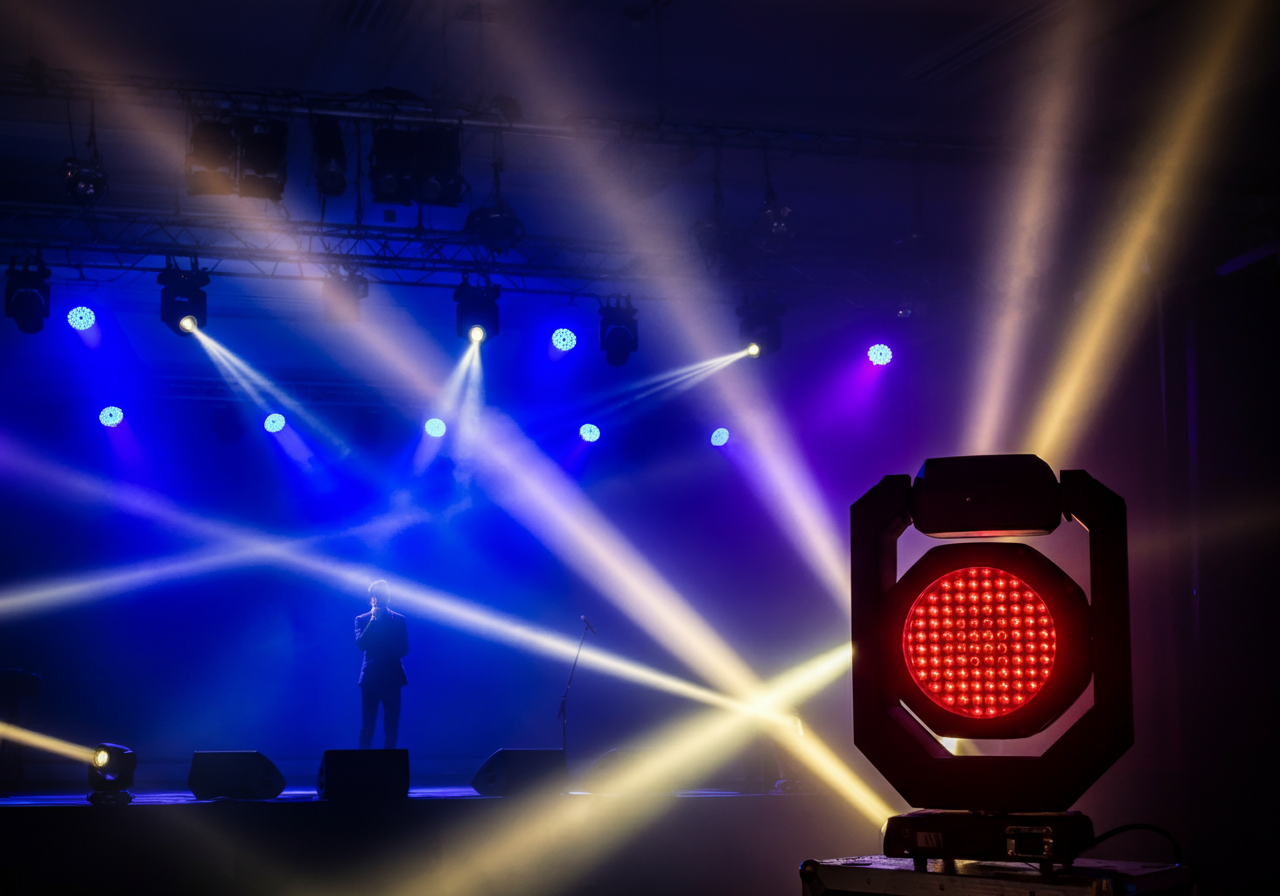
Some people walk into a venue and notice the stage. Others notice the sound. Professionals tend to look up first. The behavior says a lot because stage lighting influences how an entire event feels long before anyone understands why. A single beam can lift a performer out of a dark room or flatten the mood if it is off by even a few degrees. Lighting may seem like hardware and cables at first glance, yet the way it interacts with movement, sound, and space gives it a kind of quiet authority.
Stage lighting appears straightforward on paper. Light hits a subject and reveals it. That is the simplest version. The real practice is far more layered. Every fixture, whether a Fresnel light or a modern LED stage light, operates with a purpose that combines optics, color science, electrical behavior, and a bit of intuition. Lighting designers often say they learn something new each time a rig is built because the environment always shifts. Humidity, ceiling height, haze texture, power distribution, and even the performer’s costume can change how the light behaves.
Imagine a concert with house lights fixed at one level, the band is visible, but the atmosphere falls flat. Stage lighting shapes visibility, mood, depth, and motion. It guides attention, hides unwanted areas, and creates emotional impact. Designers consider fixtures, controls, rigging, and creative choices, often speaking in terms of wash lights, spotlights, angles, and colors or even painting-like metaphors.
The equipment behind a show rarely sits in the spotlight, yet every event relies on a mix of technical elements working in sync. The major components usually include:
The category ranges from classic PAR can light units to moving head lights capable of sweeping the room with precise control. LED stage lights, once considered a novelty, now dominate because of lower heat, lower power draw, and long service life. Some venues still keep halogen Fresnel light units because of their soft edges, but many are transitioning to LEDs that mimic those qualities. Professionals pick fixtures based on beam angle, intensity, color mixing, and how well they integrate with the rest of the rig.
A DMX controller acts as the communication backbone. It sends instructions to each fixture, telling it when to dim, tilt, shutter, or change color. Larger venues may chain multiple universes together, sometimes using Ethernet-based protocols like Art-Net. The sophistication varies. A club DJ might run a compact controller with automated scenes while a touring production maps hundreds of cues across multiple consoles.
It is believed that the most overlooked part of stage lighting equipment is the structure that physically supports everything. Truss, safety cables, chain motors, power conditioners, and data distribution all fall into this category. A fixture is only as reliable as the environment holding it. Many production companies invest more in rigging safety than in the lights themselves because the consequences of failure can be severe.
Stage lighting types overlap quite a bit, yet each has a characteristic look. A few examples help illustrate the differences.
Narrow. Focused. Designed to isolate a performer or object. Spotlights are common in theater, where attention must follow an actor across the stage. Some designers critique them for being too sharp in intimate venues, but that depends on lensing and angle.
Wash lights create broad areas of color and softness. They fill space rather than target specific points. Concerts rely on washes for depth and consistency. Houses of worship use them for gentle illumination that avoids harsh highlights.
Utility rather than drama. Floodlights cover wide zones, often backstage or around architectural elements. Their role is functional, though some designers use them creatively when texture is needed.
These include strobes, pixel bars, lasers, rotating beams, and other fixtures designed for impact. DJs use them heavily. Some technicians argue that effect lights should complement rather than dominate because too much movement can distract from the performance.
A category that blends function and expressiveness. Moving heads handle spot, wash, and beam roles depending on the internal design. They are essential for stage lighting for concerts because the ability to sweep, chase, and reposition mid-show adds energy. Their mechanical parts require regular maintenance, yet the versatility often offsets that requirement.
People tend to remember what they felt, not what they saw. Lighting shapes that emotional signature. A gentle amber wash can soften a room, while a cold blue spotlight can introduce tension. In theater, subtle changes reveal shifts in time or intention. In concerts, dynamic looks give rhythm a visual counterpart. Even minor decisions like lens type or gel selection affect perception, and audiences process light cues almost subconsciously. Some studies note that lighting changes can influence applause patterns.
Stage lighting for concerts emphasizes movement, contrast, and timing. Beam fixtures cut through haze to create sharp lines. LED walls amplify color. Programmers often synchronize cues with timecode so the lighting behaves like part of the music.
Stage lighting for theater focuses more on storytelling. Designers often favor Fresnel and ellipsoidal units for their control over shape and softness. The palette tends to be gentle with gradual transitions.
The intention leans toward clarity and warmth. Quiet fixtures matter because of acoustic sensitivity. LED stage lights dominate this segment due to efficiency.
Consistency and reliability matter most. Installers prefer professional stage lighting systems that require minimal maintenance. PAR can light fixtures, spotlights, and wash units still have strong roles here.
A quick guide can clarify how professionals assign tasks to different fixture categories.
| Fixture Type | Typical Use | Visual Character |
| Fresnel light | Theater, soft wash, key light | Smooth edges, even field |
| PAR can light | General wash, concerts | Punchy, simple, predictable |
| Moving headlights | Concerts, clubs, touring | Dynamic motion, precise beams |
| Floodlights | Ambient coverage | Wide, functional |
| Spotlights and wash lights | Theater, worship, venues | Focused or blended illumination |
Regardless of industry, lighting supports the broader design system. Video teams rely on it to balance camera exposure. Audio engineers adjust their workflows when lighting rigs introduce noise or heat. Even scenic designers coordinate textures with lighting effects to avoid glare. Stage lighting, in this sense, acts as a connector between disciplines. It may not always receive credit, yet without it, the rest of the system loses coherence.
Some professionals mention an ongoing shift toward integrated workflows. It is believed that lighting, video, and effects increasingly merge within unified control systems. Whether this trend continues depends on cost, training, and whether smaller venues can adopt advanced protocols.
If you have reached the point where understanding the categories and behaviors of light fixtures seems manageable, a natural next question arises: which equipment actually holds up under real-world use? Brands vary, and most technicians build preferences through hands-on trial. One option worth keeping on your radar is Sanyi Lights, especially if reliability and straightforward control matter. Their catalog touches everything from moving head units to retro-style fixtures that suit theater and small venues. It is a suggestion more than a push. Good lighting design begins with tools that behave predictably.
Explore Sanyi Lights Today – Reliability Meets Creative Control!
A few elements tend to reveal whether a fixture belongs in a professional environment.
Optics: Sharp beams require quality lenses. Inexpensive fixtures may scatter light unexpectedly.
Dimming Behavior: Smooth fades matter. Harsh steps break immersion, especially in theater.
Cooling and Noise: Fans can disrupt quiet rooms. LED stage lights help reduce heat, though noise levels still vary by model.
Control Options: Support for DMX, RDM, and networked protocols ensures long-term flexibility.
Build Quality: Rigging points, housing, and connectors hint at durability. Some technicians critique plastic components, arguing that metal frames handle touring stress better.
Even with advances in technology, stage lighting introduces difficulties. Matching color across mixed fixtures can be inconsistent. Ambient light from LED screens sometimes washes out subtle looks. Power availability limits what smaller venues can run. Programmers may need more rehearsal time to achieve nuanced results. These constraints rarely disappear entirely. The aim is to work within them without compromising the show.
Stage lighting continues to evolve, yet its purpose remains surprisingly steady. It reveals, shapes, and directs, just like event lighting that quietly enhances an atmosphere without calling attention to itself. It may even change how people remember an event. Once you begin noticing its influence, it becomes difficult to unsee how much it contributes to every environment. The field grows, new equipment appears, and designers experiment, but the core idea stays open-ended, almost unfinished.
Concert rigs often rely on moving head lights, PAR can light units, and wash fixtures that cut through haze.
It appears to be the trend. LED stage lights offer lower energy use and smoother color mixing.
Yes. Many designers prefer the soft edges and predictable falloff of the Fresnel light, even as LEDs take over other categories.
A DMX controller serves as the backbone, sometimes supported by Art-Net or RDM for advanced setups.

