
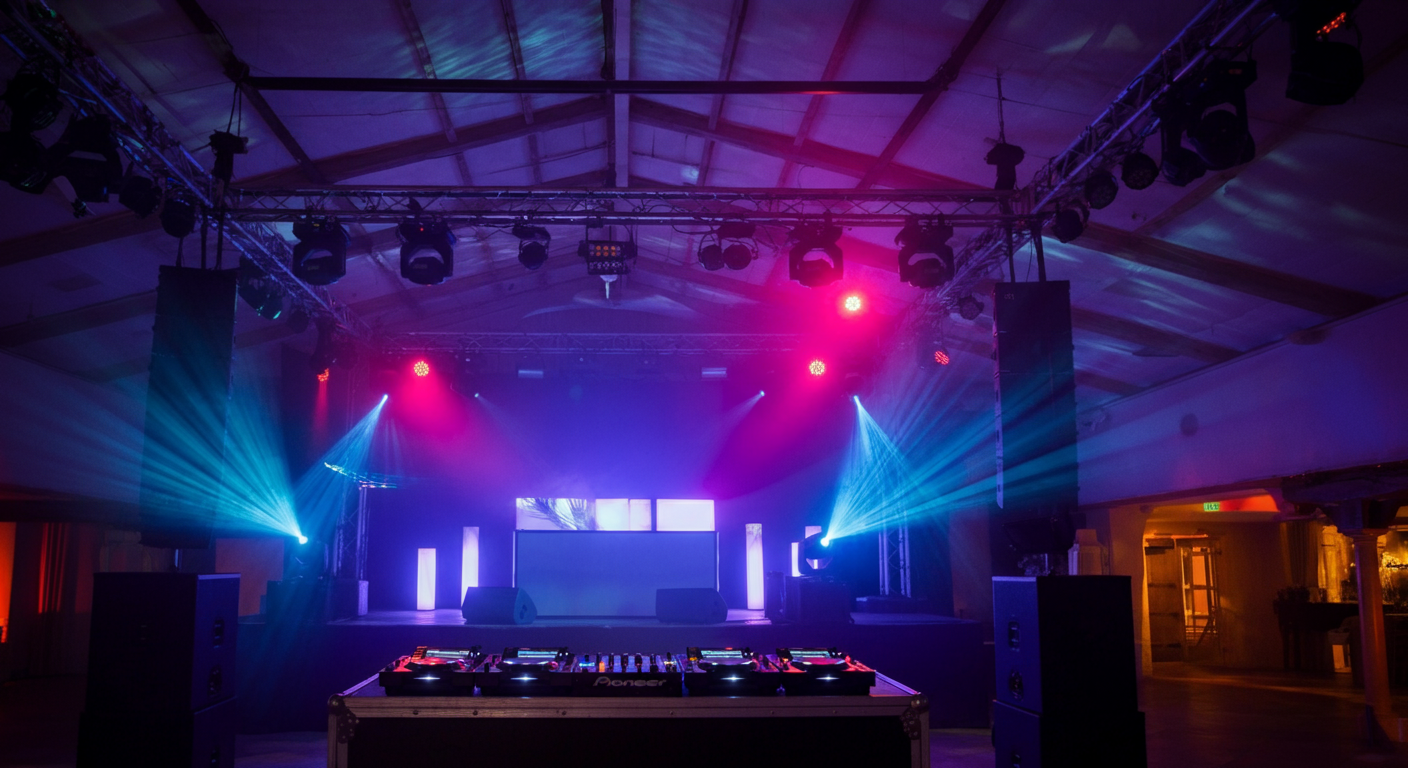
Walk into an empty venue before doors open. No music yet. No crowd. Just walls, ceiling height, power outlets, and silence. This is where a DJ light setup actually begins, not with fixtures, but with decisions. Poor ones show immediately once the room fills. Thoughtful ones fade into the background and let the event breathe.
Lighting rarely gets a second chance. Once guests arrive, adjustments become compromises.
This guide breaks down how experienced planners approach DJ lighting with intention, restraint, and awareness of real-world constraints.
A DJ light setup is not decoration. It functions as a direction. It tells guests where to look, when to move, and when to pause.
Some events demand restraint. Others ask for constant motion. The mistake appears when lighting ignores context.
Weddings, brand launches, clubs, and outdoor festivals all react differently to DJ Lighting. A wedding crowd often responds better to warm wash light early, then gradual movement later. Concert lighting leans harder into contrast, beams, and visible motion from the first song.
Dynamic lighting may energize a crowd, but overuse can feel chaotic. It appears balance, not intensity, carries the room.
Venues lie on spec sheets. Ceiling height may vary. Pillars block beams. Wall color absorbs light unpredictably.
Before planning a DJ light setup, note three details.
Stage Lighting that works in black box venues may fail in ballrooms flooded with uplights and mirrors.
Outdoor events remove walls from the equation. Wind, distance, and ambient city light alter everything. Moving head lights for DJs often need higher output outdoors to remain visible. Wash light spreads too thin if not planned carefully.
No setup needs everything. Most need the right few tools placed intentionally.
Wash light establishes atmosphere. It fills space quietly. LED Stage Lighting excels here due to color consistency and low heat. Wash fixtures define mood without demanding attention.
Moving Head Light fixtures introduce movement, texture, and timing. When used sparingly, they guide attention toward drops, announcements, or performers. When overused, they distract.
It is believed that limiting movement to musical peaks improves audience comfort.
Beam-focused fixtures sharpen the visual field. Concert lighting relies heavily on these for depth. Not every DJ light setup needs beams, but large rooms often benefit from controlled contrast.
Ten poorly placed fixtures cannot fix bad angles. Four well-placed ones often can.
Lighting is often planned horizontally. The ceiling gets ignored. Vertical layering adds dimension without increasing fixture count.
Stage and event lighting systems benefit when layers interact instead of competing.
Lighting failures usually trace back to planning, not equipment.
LED fixtures draw less power, yet circuits still overload when mismanaged. Separate audio and lighting circuits where possible. It reduces noise issues and protects equipment.
DMX layouts influence creativity. Poor addressing limits scenes and transitions. It may be worth simplifying the fixture count to improve control clarity.
Dynamic lighting relies more on control than raw output.
Color affects visibility, skin tone, and camera results.
Warm tones flatter faces. Cool tones widen spaces. Saturated colors reduce detail. White light reveals everything, including flaws.
A DJ light setup benefits from restraint in color selection. Two or three dominant hues often outperform full-spectrum cycling.
Lighting that ignores music structure feels detached.
Slow builds favor static wash with subtle movement. Drops tolerate sharper transitions. Continuous motion dulls impact over time.
Professional DJ lighting setup ideas often mirror song phrasing instead of tempo alone.
Experience reduces mistakes, but some persist.
It appears that restraint is harder to learn than complexity.
Future proofing matters. A DJ light setup that adapts to different venues saves cost long term.
LED Stage Lighting remains popular due to efficiency and modular expansion. Moving head lights for DJs scale well across venue sizes when chosen carefully.
| Fixture Type | Best Use Case | Limitation |
| Wash Light | Ambient coverage, mood | Limited focus |
| Moving Head Light | Motion, emphasis | Requires control |
| Beam Fixture | Depth, contrast | Needs space |
| LED Par | Uplighting, fill | Narrow impact |
Corporate events introduce brand constraints. Color accuracy matters more than motion. Stage Lighting here often prioritizes consistency.
Concert lighting leans expressive. Weddings prefer subtle transitions. DJ Lighting should align with intent, not trend.
At some point, scale complicates decisions. Larger venues, touring events, or permanent installs introduce logistics that go beyond fixture choice.
This is where experienced manufacturers and suppliers become relevant. Sanyi Lights focuses on professional stage lighting systems developed through long-term testing and global distribution experience. For planners who value consistency, reliable output, and scalable solutions, working with established lighting specialists may simplify execution without overcomplicating design.
Lighting can overwhelm. Guests should feel invited, not interrogated.
Flicker rates, brightness peaks, and angle control affect comfort. It is likely that thoughtful moderation improves event longevity, especially during long programs.
No setup survives first contact with a crowd unchanged. Real-time adjustment separates static installs from responsive environments.
A DJ light setup should allow room for subtle tuning. Locking scenes too early limits adaptability.
The room always answers back, quietly.
It depends on venue size and ceiling height. Small rooms often need fewer fixtures than expected.
Yes, provided output and weather rating match conditions.
They can, but placement and beam angle become critical.
Not entirely. Wash creates atmosphere, movement creates focus.
Yes. Neutral tones typically produce better camera results.

