
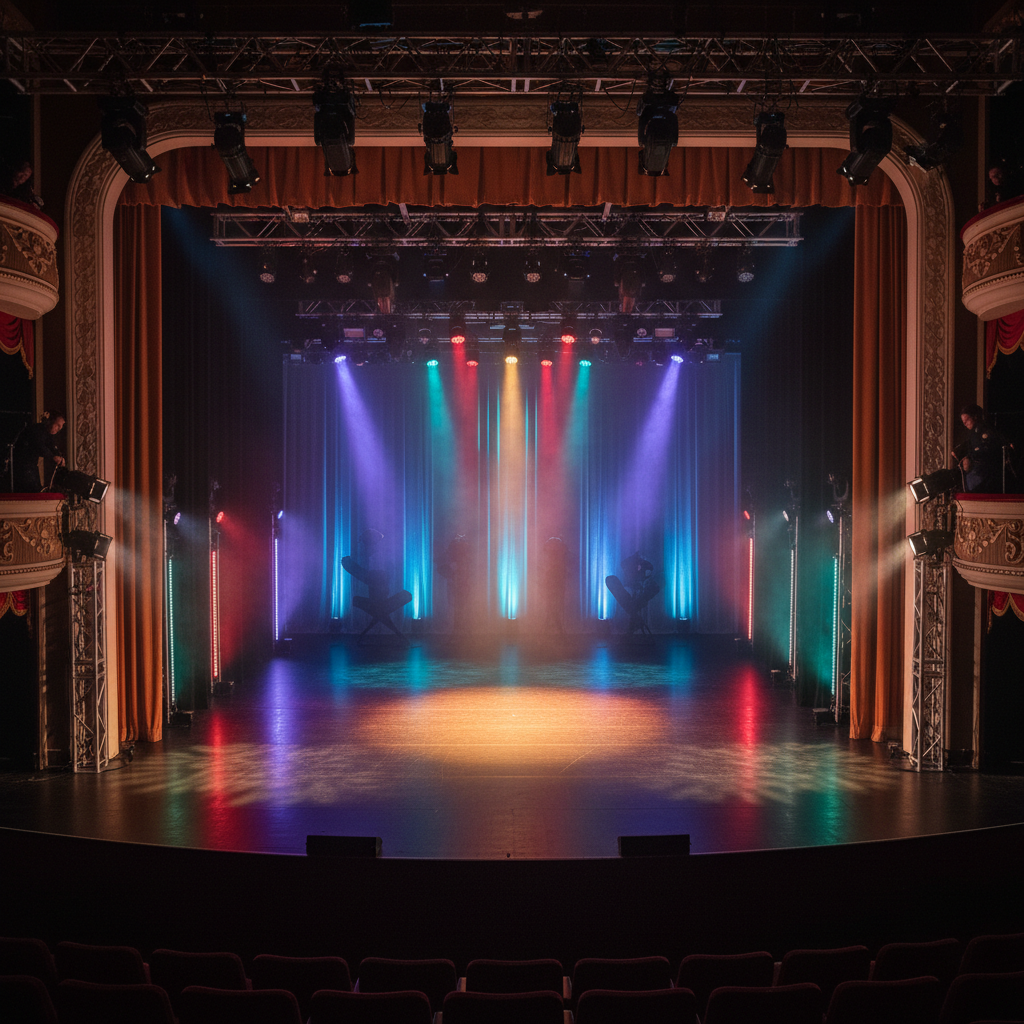
A great performance can be ruined by poor visibility, but a truly memorable production is elevated by exceptional lighting. While the actors, set, and script draw the most attention, the lighting design works quietly in the background to manipulate the audience’s emotions and direct their focus. It is the invisible art form that transforms a bare stage into a stormy ocean, a cozy living room, or a terrifying dungeon.
For those new to the world of technical theater, the vast array of fixtures, consoles, and cables can seem overwhelming. Yet, at its core, stage lighting is about controlling what the audience sees and how they feel about it. It is a blend of physics, engineering, and artistic intuition.
Whether you are a budding lighting designer, a director looking to communicate better with your tech crew, or simply a theater enthusiast, understanding the fundamentals is essential. This guide breaks down the tools, techniques, and design principles used to paint with light.
Before you can design a show, you need to know what instruments are in your toolbox. Lighting fixtures, often called “lanterns” or “luminaires,” come in various shapes and sizes, each serving a specific purpose.
Commonly known by the brand name “Leko,” the ERS is the workhorse of theater lighting. It produces a sharp, defined beam of light that can be shaped using internal shutters. You can adjust the focus to soften the edges or keep them crisp. These fixtures also have a slot for “gobos” metal or glass patterns that project shapes like leaves, windows, or abstract textures onto the stage.
Named after its distinct stepped lens (originally developed for lighthouses), the Fresnel produces a soft-edged beam. Unlike the ERS, you cannot shape the light with internal shutters. Instead, you use external flaps called “barn doors” to cut off the light from unwanted areas. Fresnels are excellent for washing the stage in color or providing general visibility without harsh shadows.
Parabolic Aluminized Reflector (PAR) cans are simple, durable, and lightweight. They produce an intense, oval-shaped beam. While they lack the precision of an ERS or the softness of a Fresnel, they are incredibly powerful. You will often see these used in rock concerts or large-scale productions to create bold washes of color.
These are the intelligent fixtures of the lighting world. Automated and programmable, moving heads can pan, tilt, change color, zoom, and swap gobos remotely. While traditionally used in concerts, they are becoming increasingly common in theater productions due to their versatility. One moving light can do the job of several static fixtures by repositioning itself throughout the show.
Owning the equipment is only the first step. How you position these lights determines the dimensionality and mood of the scene. Professional designers use a combination of angles to sculpt the actors and the set.
This is the primary source of visibility. Light hitting the actor’s face from the front ensures the audience can see expressions and movements. However, relying solely on front lighting can make the stage look flat and two-dimensional. It tends to wash out the natural contours of the face and body.
Positioning a fixture behind the actor creates a halo effect around their head and shoulders. This separates the subject from the background, adding depth to the stage picture. Backlighting is crucial for making actors pop out from the scenery, preventing them from blending into the backdrop.
Side lighting is a favorite in dance productions. By hitting the body from the wings, the light catches the contours of muscles and fabric, emphasizing movement and form. In dramatic plays, side lighting can create high-contrast, moody effects, leaving half the face in shadow to suggest conflict or mystery.
These are more dramatic, specialized angles. Uplighting (from the floor up) creates an unnatural, “spooky” look—think of holding a flashlight under your chin telling ghost stories. Downlighting (straight down from above) isolates an actor in a pool of light, which can simulate a streetlamp or a prison cell, often shrinking the stage space psychologically.
Color is one of the most powerful tools a lighting designer possesses. It bypasses the intellectual brain and speaks directly to the emotions.
Traditionally, color was added to lights using “gels” sheets of heat-resistant colored plastic placed in front of the lens. This is a subtractive process; a blue gel stops all light wavelengths except blue from passing through. Today, LED fixtures are revolutionizing this by using additive mixing. By combining Red, Green, and Blue (RGB) diodes at different intensities, LEDs can create millions of colors instantly without the need for physical gels.
The most basic division in lighting color theory is warm versus cool.
Mixing these temperatures is key to visibility. A common technique is to hit one side of the actor’s face with a warm light and the other with a cool light. This mimics natural lighting conditions (like the sun on one side and the blue sky reflection on the other) and ensures the actor looks natural rather than orange or blue.
Creating a lighting design is about more than just pointing lamps at a stage. It is a structured process that begins long before tech week.
Every design starts with the script. A lighting designer must analyze the text to determine the practical requirements (time of day, location, season) and the emotional arc. If the scene is a high-energy comedy, the lighting should likely be bright and evenly distributed. If it is a somber tragedy, shadows and contrast become your best friends.
Once the concept is solidified, the designer draws a “light plot.” This is a blueprint of the theater overheads, showing exactly where each light hangs, what type of instrument it is, what color it should be, and where it should focus. This map is what the electricians use to hang the show.
The final step happens in the theater. The designer works with the board operator to program “cues.” A cue is a snapshot of the lighting look at a specific moment. A complex musical might have hundreds of cues, while a simple play might have twenty. The goal is to make the transitions between these looks seamless, guiding the audience’s eye without distracting them from the story.
Stage lighting is a discipline that takes a lifetime to master, but the fundamentals remain consistent. It is about revealing what needs to be seen and hiding what should remain in the dark. By understanding the different types of fixtures, leveraging the geometry of angles, and utilizing the emotional power of color, you can begin to shape the visual narrative of any production.
Next time you sit in a theater, look up. Notice the angles, the color shifts, and the shadows. You will find a whole new performance happening right above the actors’ heads.

